Est. 1873 · West Palm Beach
The History of Grandview Heights
A neighborhood that has held its character through booms and busts, through decades of change pressing in from every direction.
"There is a particular feeling you get when you turn off the noise of downtown West Palm Beach and step into Grandview Heights. The streets narrow and quiet. Canopy trees close overhead. The architecture — Craftsman bungalows, Mediterranean Revivals, graceful American Foursquares — lines the sidewalks in unhurried succession."
The city's cranes and towers are only blocks away, yet they feel like another world entirely. This is a neighborhood that has held its character through booms and busts, through decades of change pressing in from every direction, and it wears that resilience the way old wood wears a finish: all the more beautiful for what it has endured.
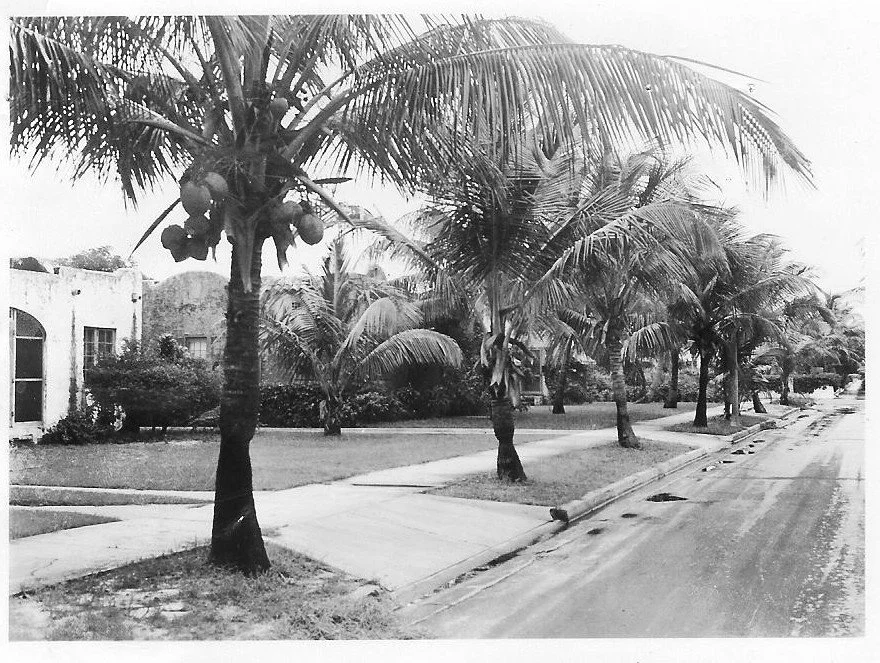
1873
The land that would become Grandview Heights was first homesteaded in 1873, a full generation before West Palm Beach was anything more than a quiet outpost on Florida's lower Atlantic coast. For nearly two decades, little changed. Then, on April 2, 1895, Henry Flagler's Florida East Coast Railway rolled into town and changed everything. The tracks — which still define the neighborhood's eastern boundary today — stitched West Palm Beach into the broader world, and the city's first real growth era began almost immediately.
That early economy ran on hospitality. Tourists flooded south to the grand Royal Poinciana and Breakers hotels on Palm Beach island, and the workers, tradespeople, and merchants who served them needed somewhere to live. The slightly elevated ridge just west of downtown, rising gently above the surrounding flatlands, offered exactly that: dry ground, cooling breezes, and long eastern views toward the Lake Worth Lagoon.
Beginnings:
A Frontier on the Ridge
1912 — 1920
Three Plats,
One Community
The formal development of Grandview Heights unfolded in three acts. In 1912, two subdivisions were recorded side by side: the Palm Beach Heights Addition, platted by Clarence Edsall and Emil D. Anthony, and the Moss & Heisler Addition, recorded on September 14, 1912 by Lewis Heisler — a charter member of the Palm Beach Real Estate Board who would later help found the Port of Palm Beach. Together they laid out the grid of streets and narrow 50-by-100-foot lots that give the neighborhood its distinctive, walkable character.
The third chapter came eight years later. On January 28, 1920, John C. Gregory platted the Grandview Heights subdivision itself — and the public responded with remarkable enthusiasm. All 65 initial lots sold within three days. A nine-day sales event that followed moved more than 100 lots.
1910S - 1925
1910s - 1925
The neighborhood began filling in around 1910, its first residents a telling cross-section of early West Palm Beach: ministers, downtown shopkeepers, and the skilled craftsmen who had built the luxury hotels of Palm Beach island with their own hands. By 1916, the Tropical Sun was describing Florida Avenue as a beautifully parked, 80-foot-wide boulevard — a distinction the landscaped median along that street still preserves today.
By 1923 and 1924, the building pace was almost frantic. The Stiles C. Hall Building Company alone filled orders for 75 homes. Most historic homes were completed by 1925; by 1926, Grandview Heights was essentially fully built out. West Palm Beach's population climbed from 8,659 in 1920 to 26,610 by 1930. Total city property values rose from $12.6 million to $89 million in that same span.
Building
the Boom
268
OF STRUCTURES ARE HISTORIC
65
LOTS SOLD IN 3 DAYS
CONTRIBUTING HISTORIC BUILDINGS
73%
1999
LISTED ON NATIONAL REGISTER
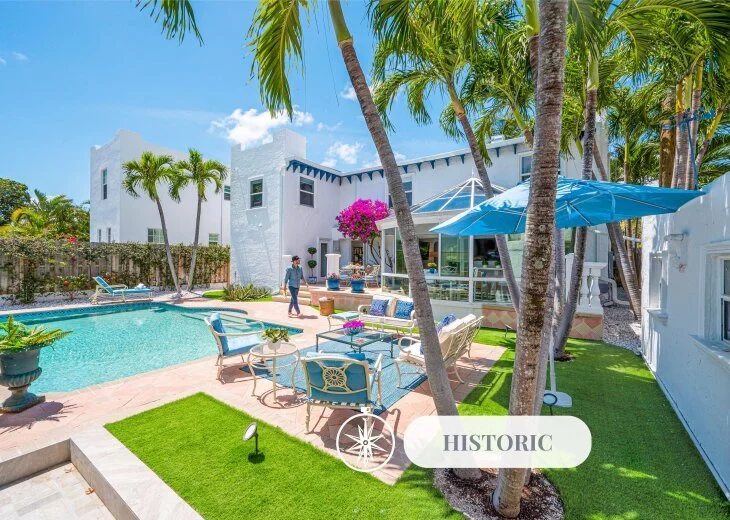
ARCHITECTURE
A Living Museum
Of the 363 structures within the neighborhood, 268 are contributing historic buildings — a remarkable 73 percent. Walking these blocks is a lesson in the architectural ambitions of early-20th-century Florida.
Mediterranean Revival home in Grandview Heights.
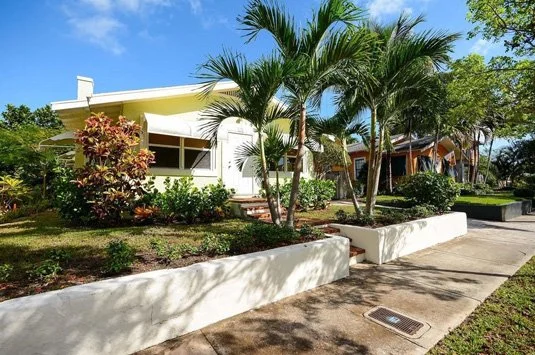
Historic cottage in Grandview Heights
Craftsman Bungalows beside Mission Revival homes and American Foursquares, Frame Vernacular and Masonry Vernacular cottages near examples of Mediterranean Revival, Dutch Colonial Revival, Art Deco, and more. The narrow lots, rear alleyways, porte-cocheres, and continuous sidewalks create a pedestrian rhythm that newer neighborhoods rarely achieve.
Among the most poignant architectural stories here: three Mediterranean Revival homes were physically relocated into Grandview Heights in the 1980s from the adjacent Hillcrest neighborhood, which was demolished for redevelopment. Rather than see them lost, the community found a way to keep them standing.
1926 - 1980s
Hard Times & Hard Choices
The boom could not last. The Florida Land Boom collapsed in 1926, followed by two devastating hurricanes. A third storm struck in 1928, destroying nearly 8,000 homes countywide. The stock market crash of 1929 and the Great Depression halted construction across the region. By the 1980s, crime had risen and the neighborhood had stagnated.
The City of West Palm Beach acquired roughly half its properties and demolished them for a downtown revitalization plan. What rose from those cleared blocks — the Kravis Center for the Performing Arts, Rosemary Square, and the Palm Beach County Convention Center — transformed the city's core but came at a profound cost to the neighborhood's fabric.
1990s - Today
Reclaiming the Ridge
The revival of Grandview Heights belongs to its residents. In the 1990s, a grassroots preservation movement took hold. Neighbors organized, documented the neighborhood's architectural legacy, and filed a nomination for the National Register of Historic Places. That effort — led by Amy Groover, Jo-Anne Peck, Carl Shiver, and the Florida Bureau of Historic Preservation — succeeded on July 8, 1999, when Grandview Heights was officially listed (NRHP #99000795).
Today, Grandview Heights is one of the most sought-after communities in West Palm Beach, with home values from the mid-$700,000s to over $2 million. It is anchored by Howard Park — the largest urban park in West Palm Beach, built on the site of the historic Stub Canal Turning Basin — and the Armory Arts Center, constructed in 1939 with WPA funds and still a vital center of cultural life.
STEWARDSHIP & THE WORK AHEAD
The Neighborhood’s Greatest Asset
A neighborhood like Grandview Heights does not sustain itself on its own. The architecture endures because residents care for it. The history stays visible because someone takes the time to tell it. And the sense of peace that settles over these streets — that rare, almost startling quiet you feel stepping in from the surrounding city — endures because a community has chosen, generation after generation, to protect what makes this place worth protecting.